
You’re Already Planning for a Disaster… and Don’t Even Know It
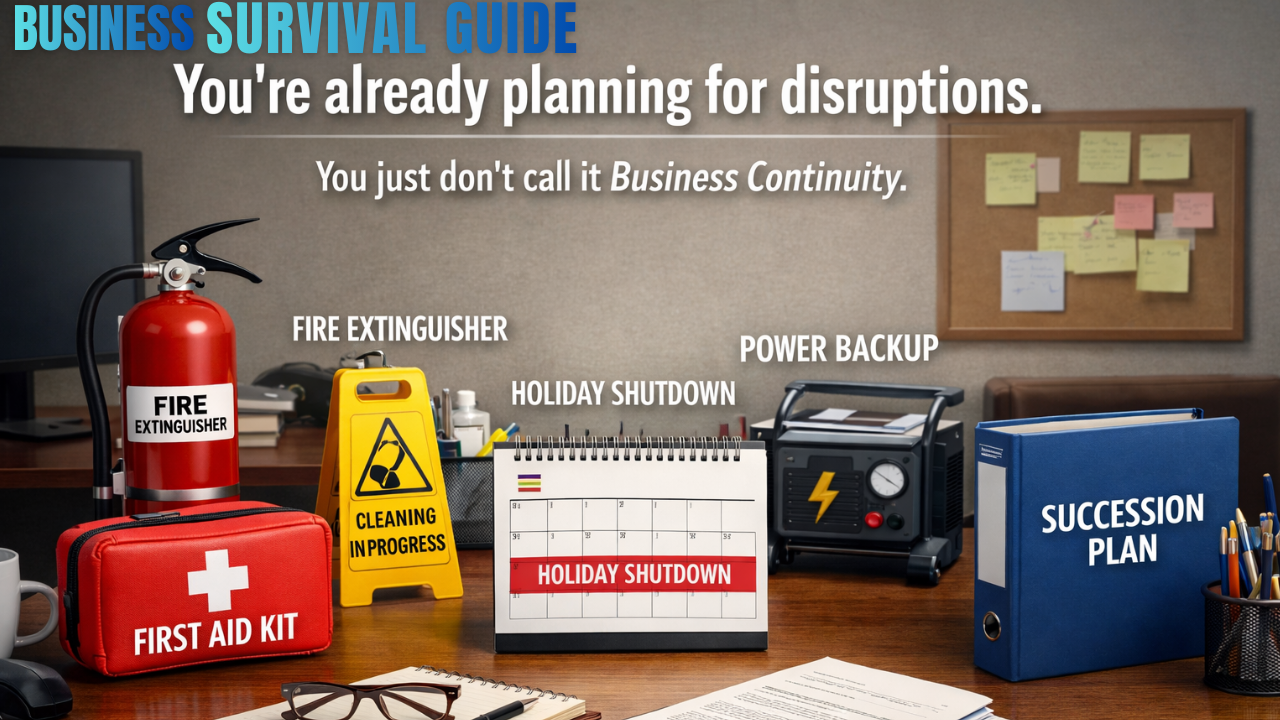
You’re Already Planning for a Disaster… and Don’t Even Know It
One of the most common things I hear when talking with business owners about Business Continuity Planning is some version of the same statement, delivered with complete confidence:
“We don’t have a business continuity plan.”
And to be fair, most of them are telling the truth. There’s no thick binder on a shelf labeled Business Continuity Plan. No emergency playbook sitting in a shared drive. No committee meetings dedicated to “disaster scenarios.”
But then the conversation continues and I start asking a few simple questions.
“Do you shut or scale down between Christmas and New Year’s?”
“Yes.”
“Do you bring in cleaners once a year to deep clean the building?”
“Of course.”
“Do you have smoke detectors and fire extinguishers?”
“Well… obviously.”
“First aid kit?”
“Right by the break room.”
And at that point, I usually smile.
Because they do have a continuity plan, they just don’t call it one.
What they actually have is a collection of practical decisions made over time to reduce risk, handle disruptions, and keep the business running when things don’t go exactly as expected. It may not look like formal Business Continuity Planning, but the thinking behind it is exactly the same.
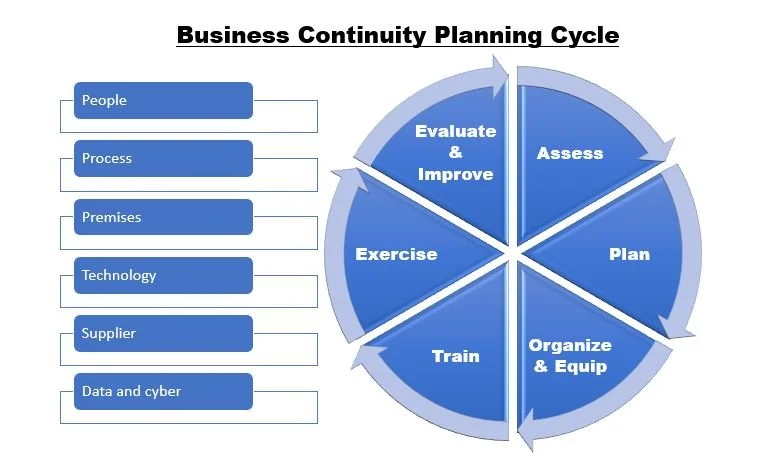
Business Continuity Planning Cycle
The Client Who “Didn’t Believe” in Business Continuity
A few years ago, I was sitting across from a business owner who told me, without hesitation:
“We don’t need business continuity planning. We’re too small for that.”
This was a good company. Profitable. Tight team. Smart leadership. Not reckless — just practical. In his mind, disaster planning was something for hospitals, airports, or massive corporations with compliance departments and laminated badges.
So I asked him one question.
“What happens the week between Christmas and New Year’s?”
He laughed. “Nothing. We shut down.”
“Why?”
“Well… nobody’s here. Customers aren’t buying. Vendors are closed. It’s slow.”
Exactly.
Without realizing it, he had already evaluated staffing risk, vendor responsiveness, revenue cycles, and operational slowdowns — and made a strategic decision to reduce exposure during a predictable disruption window. That is Business ContinuityPlanning. Not a binder, not a certification, a series of decisions that led to a plan. Business continuity planning isn’t a dramatic response to catastrophe. It’s thoughtful preparation for interruption and most leaders are doing it instinctively.
Vacation Closures: Your First Continuity Plan
When businesses close or scale back operations during certain times of the year like summer or at the end of the year, they are acknowledging several realities:
Key people won’t be available.
Vendors won’t respond quickly.
Customers won’t transact normally.
Productivity will drop.
Rather than fight that reality, they adjust to it. They compress deadlines. They pre-order supplies. They move billing cycles. They communicate expectations. In short, they reduce operational risk during a period where disruption is predictable.
No one calls this “continuity planning.” It’s just common sense.
But common sense applied consistently is exactly what keeps companies stable.
The interesting thing is this: if leaders are this thoughtful about a slow holiday week, imagine what could happen if they applied the same structured thinking to less predictable disruptions.

Out of office
Renovations, Upgrades, Utility Outages and Controlled Chaos
Every time you schedule a renovation, a system upgrade, or even a deep cleaning, you know disruption is coming.
So you:
Notify employees in advance.
Adjust work schedules.
Protect equipment.
Reroute workflows.
Sometimes relocate operations temporarily.
You don’t just show up Monday morning and hope drywall dust doesn’t settle into every keyboard in accounting. You don’t replace your phone system and assume everyone will just “figure it out.” You plan around the interruption, identify what could go wrong and buffer for it.
That is Business Continuity Planning — just under a different name.
The key difference is that construction is a scheduled disruption. Storms, cyberattacks, sudden resignations, and supply chain failures are not. But operationally, the mindset is the same: protect what matters most and keep the business moving.
Office Renovations and Construction
Smoke Detectors, Sprinklers, and the Things We Hope We Never Use
Another key indicator for risk readiness is to assess common emergency preparedness items like fire detection and suppression equipment, first aid supplies and backup utilities like power and internet. Every time someone tells me they don’t plan for disasters, I ask if they have smoke detectors. The answer is usually “Obviously.”
That’s interesting…you don’t expect a fire, but you acknowledge the possibility. You invest in protection for an event you hope never happens — because the cost of being unprepared is catastrophic.
Look at the past few years alone. Hurricanes that shut down entire regions. Wildfires forcing evacuations with hours’ notice. Businesses displaced for months. Or consider the wave of ransomware attacks that paralyzed hospitals and mid-sized companies alike. None of those leaders woke up that morning expecting crisis. Many assumed it wouldn’t happen to them.
Yet we prepare for fire because we understand one simple truth: low probability does not mean low impact.
Business Continuity Planning operates on the same principle.
Preparing For the Future
One of the most common forms of “accidental” continuity planning happens when business owners start thinking about retirement or eventually selling the company. At some point, every owner realizes the same thing: if the business can’t run without them, it isn’t really a business — it’s a job with overhead. So they start documenting processes, delegating responsibilities, and identifying the people who could eventually step into leadership roles. What often starts as a personal retirement plan quickly becomes a roadmap for keeping the business stable when its most important leader eventually steps away. This is what forms the basis of Succession Planning.
That preparation usually involves mapping out key responsibilities and making sure others understand how the company actually operates. Owners begin cross-training managers, documenting institutional knowledge, and making sure critical decisions aren’t locked inside one person’s head. They identify potential successors and begin grooming them through expanded responsibilities, mentoring, and leadership opportunities. None of this feels like “disaster planning.” It feels like smart leadership and long-term business stewardship.
But in reality, this is one of the most important forms of continuity planning a company can do. When leadership transitions are planned, businesses remain stable, employees feel confident about the future, and customers experience little disruption. Formalizing that process does not have to be complicated either. In fact, it can often be captured on a single page. We outline a simple approach in our 1-Page Succession Plan in 5 Steps article, which shows how even small organizations can put a practical succession framework in place without turning it into a major project.
Now Think About Every Disruption You’ve Had
Let’s reflect for a moment. Think back over the disruptions your business has already experienced. Think about:
Every storm
Every power outage
Every key employee who called out at exactly the wrong time
Every pipe burst that turned a normal morning into a facilities emergency.
The technology failure that froze operations for half a day.
The supply chain delay that forced you to improvise with customers.
Most businesses can build a pretty long list once they start thinking about it.
In those moments, you adapted. Someone probably ran to Home Depot at 6:30 a.m. for a sump pump or space heaters. Phones got rerouted to cell phones so customers could still reach someone. Accounting processed invoices manually when the system went down. And maybe the biggest lesson of all — you realized one employee held far too much institutional knowledge, so you started cross-training others.
But the real question isn’t what you did in the moment. It’s what changed afterward.
Maybe you installed a backup generator. Maybe you moved critical systems to the cloud. Maybe you documented a process that previously lived only in someone’s head. Maybe you diversified vendors so one delayed shipment couldn’t stall production again. Those adjustments weren’t random reactions — they were lessons turned into safeguards. The companies that survive long term aren’t the ones that avoid disruption. They’re the ones that learn from it and come out stronger on the other side.
Lesson Learned
The Slightly Uncomfortable Question
Here’s where the conversation shifts. Most businesses are already good at preparing for the everyday risks. They lock up the building at night, maintain insurance, keep basic safety equipment on hand, and hopefully back up their data somewhere other than the computer under someone’s desk. These are practical, sensible precautions — the kind of habits that responsible companies develop over time.
For example, most organizations already do things like:
Lock and secure their facilities every night
Maintain property and liability insurance
Back up critical data and systems
Keep fire extinguishers, alarms, and basic safety equipment in place
Those steps make sense because the risks feel familiar. Theft, fire, and equipment issues are easy to imagine, so businesses naturally prepare for them. Where things get more difficult is when leaders step back and consider the larger disruptions that could impact operations. The questions become less routine and a little more uncomfortable:
What would we do if we lost access to our building for 30 days?
What happens if our top two revenue drivers are unavailable for a week?
If our systems failed on our busiest day of the year, what’s the backup plan?
Most companies don’t avoid these questions because they are irresponsible. They avoid them because the scenarios feel abstract — something that happens somewhere else, to someone else. But ask the business owners who suddenly couldn’t access their offices during civil unrest, wildfire evacuations, or extended power grid failures. For them, continuity planning stopped being theoretical overnight. It became operational survival.
You Don’t Need a Binder. You Need Reflection.
If you want to turn all of this into something practical, here’s one of the simplest exercises you can do. It doesn’t require a consultant, a workshop, or a thick binder full of policies. It just requires taking a few minutes to reflect on what your business has already experienced.
Start by looking backward:
List the last five disruptions your business experienced.
Write down what worked well during those situations.
Write down what didn’t work or created unnecessary stress.
Identify anything you changed afterward as a result.
Then ask one final question: what bigger version of this could hurt us?
When leadership teams walk through this exercise, patterns usually emerge very quickly. You start to see where the organization adapted well, where it struggled, and where a small improvement could significantly reduce future disruption.
And that’s really the point.
Business continuity doesn’t have to start with a 200-page manual or a consultant camped in your conference room for six weeks. Often it starts with something much simpler: intentional reflection. Because whether you call it disaster planning, risk management, or just common sense, most organizations are already doing pieces of this every day.
Next Step: Take the First Step Toward Better Planning
Want a simple, free way to dive deeper into your business's risk management strategy? Our Risk Assessment can help you identify key vulnerabilities and take the next steps in preparing for unexpected disruptions.
Don’t wait until the storm hits. Start planning today.

Andy Ziegler
To find out more about the services that Tempest provides and how you can Survive and Thrive, visit our website https://www.tempestrisk.com and fill our an engagement form at https://www.tempestrisk.com/contact-us
